To choose a licensed painter in NSW, start by checking their licence on the NSW Fair Trading website, ask for proof of insurance, get at least three written quotes that break down labour and materials, and inspect previous jobs in person. A licensed contractor carries a minimum of $20,000 in public liability cover and is legally required for any residential painting work valued over $5,000.
I have been painting homes across Orange, Bathurst, Millthorpe, Blayney, and Carcoar for over fifty years now. In that time I have seen plenty of homeowners get burned by unlicensed operators who undercut on price, skip the preparation, and disappear when problems show up six months later. Choosing the right painter is not complicated, but it does require knowing what to look for. Here is the complete checklist I wish every homeowner had before picking up the phone.
Step 1: Verify Their NSW Contractor Licence
In New South Wales, any painting work valued at more than $5,000 (including materials) must be carried out by a licensed contractor. This is not optional. It is the law under the Home Building Act 1989. The licence number should be printed on their quotes, invoices, and advertising. If it is not there, that is your first red flag.
You can verify any painter's licence for free on the NSW Fair Trading licence check website. It takes about thirty seconds. Look for the licence holder's name, the licence number, the type of work they are authorised to do, and whether the licence is current. An expired or suspended licence is the same as no licence at all.
For jobs under $5,000, a licence is not legally required, but I would still recommend hiring someone who holds one. A licence tells you the painter has completed the relevant trade qualifications and has met the financial and insurance requirements set by the state government.
Step 2: Check Their Insurance
A good painter carries two types of insurance: public liability and workers compensation (if they have employees). Public liability protects you if the painter accidentally damages your property, a neighbour's car, or if someone is injured on site. Workers compensation covers their team if someone gets hurt on the job.
Ask to see a current certificate of currency, not just a policy number. Certificates are easy to obtain from any insurer, and any legitimate painter will hand one over without hesitation. If they get defensive or vague about insurance, walk away. The minimum public liability cover you should expect is $5 million for residential work and $10 million for commercial jobs.
Step 3: Get at Least Three Written Quotes
Never accept a verbal quote. A proper written quote should include a detailed scope of work, the preparation steps involved, the specific paint products and colours to be used, the number of coats, a timeline for completion, and a total price with GST clearly stated. Anything less is guesswork dressed up as a quote.
In the Central West NSW region, here are some rough price guides for 2026 to help you compare:
- Interior repaint of a 3-bedroom home: $4,500 to $8,000 depending on condition, ceiling height, and paint quality.
- Full exterior repaint of a weatherboard home: $8,000 to $18,000 depending on size, access, and the amount of preparation needed.
- Single room repaint (walls and ceiling): $800 to $1,500.
- Deck staining and sealing: $1,200 to $3,500 depending on size and timber condition.
If one quote is dramatically lower than the others, ask why. It usually means they are cutting corners on preparation, using cheaper paint, or skipping coats. The cheapest quote almost never delivers the best result.
Step 4: Ask About Preparation
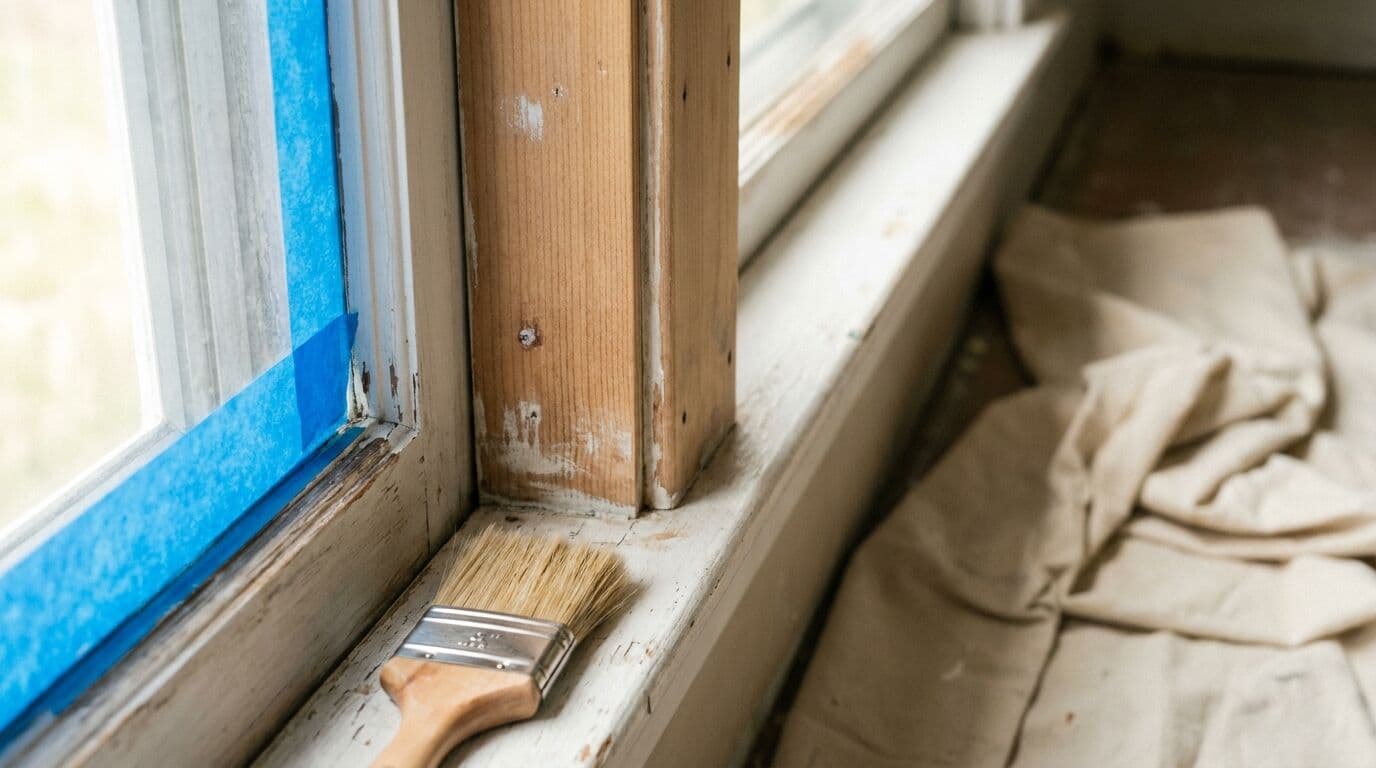
This is where the real difference between a good painter and a cheap one shows up. Preparation accounts for roughly 60 to 70 percent of the total labour time on a quality paint job. It includes washing, sanding, scraping, filling cracks and holes, priming bare timber, sealing knots, caulking gaps, and masking off areas that should not be painted.
Here in the Central West, preparation is even more critical than in milder climates. At 862 metres elevation, Orange gets frost for five to eight months of the year, and summer temperatures regularly push past 35 degrees. That constant expansion and contraction of timber and render cracks paint films faster than anywhere on the coast. Add in some of the highest UV levels in the state and you have a climate that punishes shortcuts within a couple of seasons.
Ask your painter specifically what preparation they plan to do. If the answer is vague or they skip over it, they are not going to deliver a job that lasts. A painter who talks confidently about prep is a painter who understands what makes paint stick and stay stuck.
Step 5: Ask What Paint They Use
The paint itself matters enormously. We use Dulux products on almost every job because the coverage, durability, and colour accuracy are consistently reliable. Premium paints like Dulux Weathershield for exteriors and Dulux Wash and Wear for interiors are formulated to handle the conditions we deal with out here.
Cheaper paints fade faster, chalk sooner, and do not resist mould as well. On an exterior job in a place like Bathurst or Orange, the difference between a premium paint and a budget product can be three to five years of extra life. Over a twenty-year period, that saves you an entire repaint cycle, which more than covers the small upfront cost difference.
Ask your painter what brand and product line they plan to use, and whether it is included in the quoted price. Some painters quote with cheap paint and then offer a premium upgrade at extra cost. You want to know exactly what you are paying for before work starts.
Step 6: Check Their Previous Work
Any experienced painter should be able to show you examples of completed jobs. Photos are fine as a starting point, but nothing beats driving past a house they painted two or three years ago to see how it is holding up. Fresh paint always looks good. The test is how it looks after a couple of Central West winters.
Ask for references from recent clients and actually call them. Questions worth asking include: Did they start and finish on time? Did they clean up properly each day? Were there any issues, and if so, how were they handled? Would you hire them again?
Online reviews on Google and local community pages are also helpful, but take individual reviews with a grain of salt. Look for patterns over time rather than one or two complaints.
Step 7: Confirm Who Will Be On Site
This is something most homeowners forget to ask. Will the person who quoted the job actually be there supervising the work? Or will they send a crew and disappear until it is time to collect payment?
At Murrays Painting, every job is owner-supervised. I am on site throughout the project because quality control cannot be delegated to someone who does not have their name on the business. When the owner is present, decisions get made faster, problems get caught earlier, and the standard stays consistent from the first wall to the last.
Ask your painter directly: who will be managing the job day to day? If the answer is unclear, that tells you something about how they run their business.
Step 8: Understand the Contract and Warranty
For any job over $5,000, a written contract is a legal requirement in NSW. The contract should cover the full scope of work, the total price, the payment schedule, the expected start and completion dates, the cooling-off period (5 business days for jobs over $5,000), and any warranty on the work.
A standard warranty for professional painting work is 2 to 5 years, depending on the type of job. Exterior work in harsh climates like ours typically carries a shorter warranty because the conditions are more demanding. Ask what the warranty covers and what it does not. Peeling caused by poor preparation is a warranty issue. Fading caused by twelve months of relentless UV is normal wear.
Never pay the full amount upfront. A reasonable payment structure is a deposit of 10 to 20 percent, a progress payment at the halfway mark, and the balance on completion once you have inspected the finished work and are satisfied.
The Quick Reference Checklist
Before you sign anything, run through this list:
- NSW contractor licence verified on the Fair Trading website.
- Current public liability insurance certificate sighted.
- Workers compensation insurance confirmed (if they have employees).
- Written quote with detailed scope, paint products, and number of coats.
- Preparation process clearly explained.
- Premium paint brand specified (Dulux or equivalent).
- References checked and previous work inspected.
- Owner or qualified supervisor confirmed to be on site.
- Written contract with warranty terms for jobs over $5,000.
- Payment schedule agreed, with no full upfront payment.
If a painter ticks every box on that list, you are in safe hands. If they cannot satisfy even a couple of those points, keep looking. There are good painters out there who do the right thing. You just need to know what questions to ask.
A Word About the Central West
Painting in Orange, Bathurst, Millthorpe, Carcoar, and Blayney is not the same as painting in Sydney or on the coast. The altitude, the frosts, the summer heat, and the UV create a unique set of challenges that not every painter understands. When you are choosing a painter for a property in the Central West, local experience matters. Someone who has painted through fifty winters up here knows things that a painter from the city simply will not.
If you are looking for a licensed, insured, and experienced painter in the Central West NSW region, Murrays Painting offers free, no-obligation quotes for residential and commercial work across Orange, Bathurst, and surrounding towns. Every job is owner-supervised, uses Dulux products, and comes with a clear written quote so you know exactly what you are paying for before a single brush hits the wall.